
WordPress market share just dipped below 43% for the first time since 2022. And predictably, the “WordPress is dead” crowd has come out in full force.
But what caught my attention wasn’t the number itself. It was who’s saying it, and what they’re actually recommending instead.
Table of Contents
The Yoast Founder Weighs In
The creator of Yoast SEO, arguably the most downloaded WordPress plugin in history, recently said that WordPress is overkill for a lot of small businesses. Coming from someone who built their entire career on WordPress, that’s a statement worth paying attention to.
And he’s not alone. An SEO professional posted a video this week telling people to stop using WordPress for client websites entirely. His argument: most service businesses have static sites where everyone sees the same thing. You don’t need a dynamic CMS for that. You’re paying for hosting, plugins, security updates, and dealing with plugin conflicts when you could be using a simpler setup.
His alternative? A combination of Astro, Claude Code, Cloudflare, and Resend. Three of the four are free. He showed two real case studies with Google Search Console data, including a business that went from 4 leads a month to 4 leads a week after moving away from WordPress.
That sounds compelling. And honestly, some of the points are valid.
Where They’re Right
WordPress can be overkill for a simple five-page brochure site that never changes. If you’re paying £30-60 a month for hosting and plugins on a site that sits there doing nothing, that is a lot of overhead for something static.
As Joost de Valk put it: “For the millions of sites that are some pages and maybe a blog, you don’t need a CMS. You need a website.” And he’s right. If you’re a solo blogger, a personal portfolio, or a local business with a handful of pages that rarely change, there are simpler options out there.
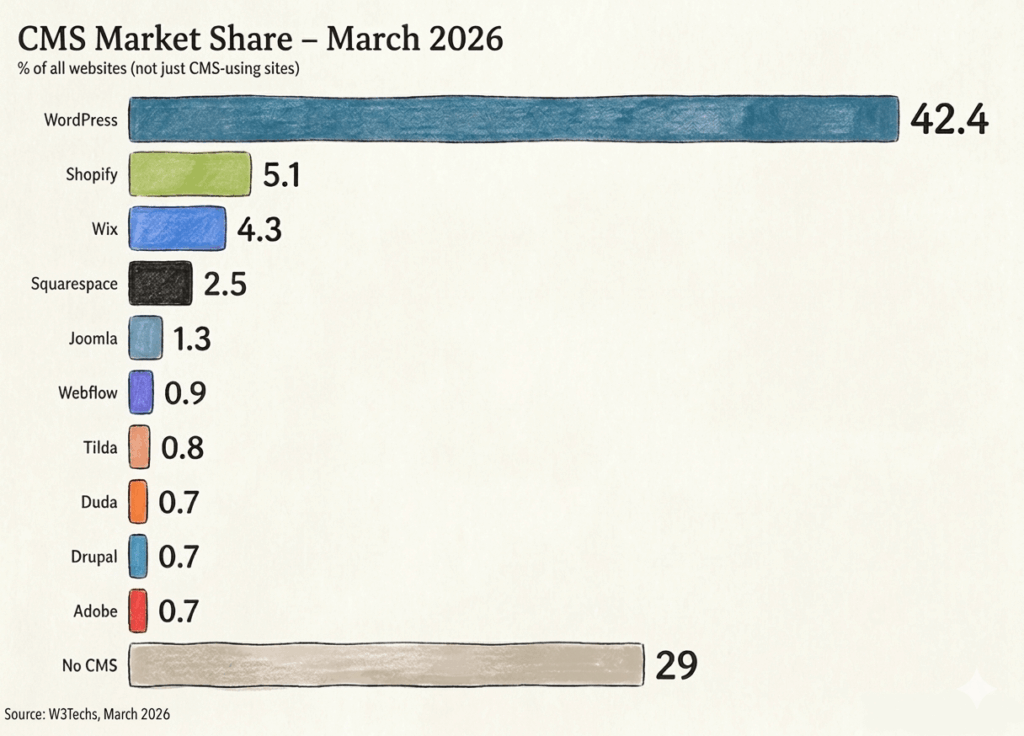
The WordPress market share data backs this up. The category that grew wasn’t Wix or Squarespace. It was “None” – sites built with no detectable CMS at all. That went from 28.6% to 29%, the first increase in over a decade. AI-built static sites are entering the market at the bottom end, and for that use case, they work.
I manage over 100 client websites. I’d be lying if I said every single one of them needs WordPress. Some of them probably don’t. But the ones that are growing, adding content, selling products, taking bookings, running email campaigns – they absolutely do.
Where They’re Wrong
Here’s what gets left out of these conversations.
That 4-tool setup he’s recommending requires you to understand Astro, a JavaScript framework. It requires you to use Claude Code to build the site. It requires you to configure Cloudflare deployment and set up Resend for email delivery. That is not a solution for a business owner. That’s a solution for a developer.
The moment the client says “can I update my own website?” the answer is no. Not without calling the developer. Not without technical knowledge. You’ve built something the client can never touch. This is reminiscent of 1995 when websites were new and only the ‘web specialists’ could make changes. This is 2026. No business should feel hostage to their web developer. Good luck telling that to your client.
His argument that AI will replace the admin panel – “tell a chatbot to update your opening hours and it edits the file, commits, and deploys” – assumes every business owner wants to talk to AI every time they need a small change. Most business owners want to log in, click edit, type, save. WordPress does that. A static site doesn’t.
And what happens six months later when they want a blog? Or a booking system? Or they want to sell products? Or they need a membership area? Every new requirement means going back to the developer and building from scratch. With WordPress, you install a plugin or develop a new feature and it works.
His case study showed leads going from 4 a month to 4 a week. Impressive. But he admits the first site had an aged domain with existing authority. That’s not Astro winning – that’s domain trust plus proper SEO work. I’ve seen the exact same results by properly optimising an existing WordPress site. New meta descriptions, proper headings, schema markup, speed improvements. The platform didn’t change. The SEO did. All done inside the simple to use WordPress admin that anyone can use.
His second site, a Patagonia real estate directory, is six weeks old with modest early results. Check back in twelve months when it needs content updates, design changes, and a client who wants to make their own edits.
And here’s the thing that stood out most to me: Joost de Valk moved his personal blog to a static site. But his actual business product, Rondo? He’s building that on WordPress. His blog went static. His business stayed on WordPress. That tells you everything you need to know.
“Built in about an hour” is a great headline. But websites aren’t built once. They’re maintained for years. Updates, content changes, new pages, integrations. That’s where WordPress earns its rightful position as the #1 CMS on the planet, and where a static site becomes a liability.
What the WordPress Market Share Data Actually Shows
WordPress powers 42.4% of the entire internet. The next closest CMS is Shopify at 4.6%. Then Wix at 2.3% and Squarespace at 2%. WordPress has more market share than the next ten platforms combined.
A 0.7% dip, driven by AI-generated throwaway sites entering at the bottom of the market, doesn’t change that reality.
The sites replacing WordPress aren’t the ones that need WordPress. They’re landing pages, placeholder sites, and basic brochure pages that nobody logs into, nobody updates, and most of them won’t exist in twelve months. I’ve been saying it for months inside my WP Odyssey Skool Community. If you’re core offer is to build WordPress websites with off the shelf templates and all you’re doing is replacing the content and loading in stock images, your days are numbered as a web developer. These new stats confirm this.
What This Means For You
If you’re learning WordPress, building sites for clients, or running a WordPress business, none of this should worry you. The clients who need what WordPress does, dynamic content, blog and latest news, e-commerce, scalability, ongoing updates, content management, plugin ecosystems, they still need WordPress. They’re not going to replace their SEO Blog or their WooCommerce store with an AI-generated HTML page. It would be complete madness.
What’s changed is the floor. The absolute cheapest end of the market is being automated away. If your offering is “I’ll build you a basic website for £500,” you’re competing with free AI tools. That was already a race to the bottom before AI got involved.
The opportunity is in everything above that floor. Businesses that have tried the cheap route and discovered it doesn’t work. Clients who need a real site on a real platform, maintained by someone who understands what they’re doing. That’s where WordPress professionals live, and that market hasn’t shrunk at all.
WordPress isn’t dying, even though the WordPress market share data shows a small decline. The bottom of the market is just getting cheaper. For everyone else, the platform that powers 42% of the internet isn’t going anywhere. Just wait until you see what is in store with the release of WordPress 7 next month. This will be when WordPress AI combines as one to take things to the next level.
Want to learn how to build WordPress sites that actually rank and bring in business? Join the WP Odyssey community where we cover exactly this.